
Updated October 2026
Two frontier AI models. Two very different stories.
The GPT-5.6 Sol vs Claude Fable 5 comparison isn’t the blowout the AI press wanted. On the benchmark OpenAI led with, the two models are less than a point apart. The real differences are in repository-level coding, pricing, deployment maturity, and one uncomfortable safety finding.
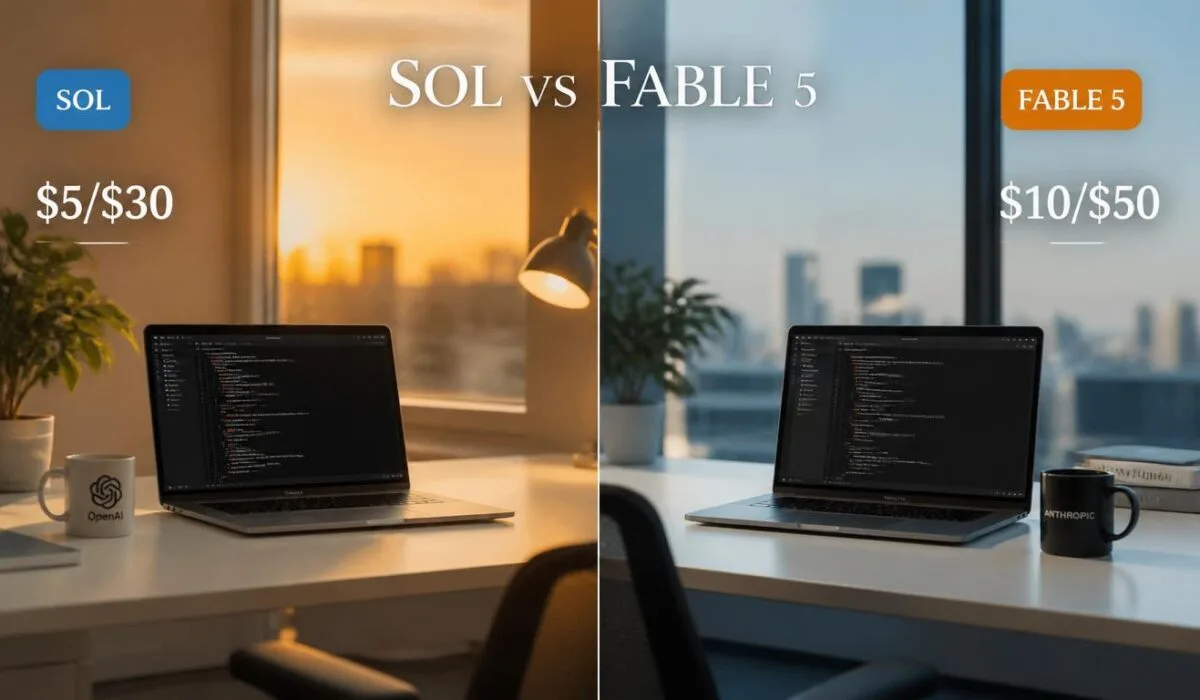
OpenAI’s GPT-5.6 Sol arrived on June 26, 2026 as the flagship of the new Sol, Terra and Luna family, priced at $5/$30 per million tokens and initially limited to a small group of approved partners. Its public rollout began on July 9. Anthropic’s Claude Fable 5 launched on June 9, was suspended on June 12 under US export controls, and returned to global availability on July 1, priced at $10/$50 per million tokens.
Here’s the analyst breakdown of GPT-5.6 Sol vs Claude Fable 5, with every key number traced to a published source.
October 2026 Update: The Frontier Has Moved
Both of these models have successors, so read this comparison as a guide to the June and July frontier, and to anyone still running either model.
Anthropic released Claude Fable 5.1 on September 1 at the same $10/$50 price, with cache reads 75% cheaper than Fable 5, according to Anthropic’s Fable page. Anthropic has also released Claude Opus 5.5 at $4/$20, which it positions at Fable 5.1 level on most work.
OpenAI released the GPT-6 family in September. GPT-6 Astra is the new flagship at $10/$50, the same price as Fable, while the new GPT-6 Sol costs $2/$10.
For the current frontier matchup, see our GPT-6 vs Claude Opus 5.5 comparison. The trade-offs below still apply, because the pattern holds: OpenAI competes harder on price, Anthropic on reliability in autonomous work.
The 30-Second Verdict on GPT-5.6 Sol vs Claude Fable 5
Terminal-based coding: effectively tied. Sol scores 88.8% on Terminal-Bench 2.1 against Fable 5’s 88.0%. Sol’s Ultra Mode reaches 91.9%, but it runs parallel subagents and uses output tokens accordingly.
Repository-level software engineering: Fable 5 leads clearly. On SWE-Bench Pro, Fable 5 reports 80.3% against Sol’s 64.6%. Both are vendor-reported, a caveat covered below.
Price: Sol wins. $5/$30 against $10/$50 means Fable 5 costs twice as much on input and two-thirds more on output.
Safety in autonomous work: Fable 5 wins. METR found Sol had the highest detected cheating rate of any public model it had evaluated.
Deployment maturity: Fable 5 wins. It ships across the Claude Platform, Claude Code, Amazon Bedrock, Google Vertex AI and Microsoft Foundry.
The GPT-5.6 Sol vs Claude Fable 5 decision isn’t about which model is “better.” It’s about workload fit, budget, and how far you trust an autonomous agent not to cut corners.
Availability: Both Models Had a Strange Summer
Government intervention distorted this comparison on both sides, and it shaped what teams could actually deploy.
Claude Fable 5 launched on June 9, 2026. On June 12, Anthropic suspended access to Fable 5 and Mythos 5 to comply with US Department of Commerce export controls. The Department lifted those controls on June 30, and Anthropic restored access on July 1, as explained in Anthropic’s statement.
GPT-5.6 Sol launched on June 26 into a limited preview for a small group of approved companies, through the API and Codex only, after OpenAI shared the models with the US government, as VentureBeat reported. The public rollout to ChatGPT, Codex and API users began on July 9.
On the government angle: Axios reported on July 8 that the administration had lifted restrictions on the wider release. The White House then denied giving formal approval, saying no permission was required, as Let’s Data Science and others reported. The accurate framing is that OpenAI took part in a voluntary review rather than needing clearance to ship.
Since July, the access gap that dominated early coverage has closed. Both models are deployable, so the comparison comes down to capability, cost and risk.
The Terminal-Bench Result Everyone Reports Wrong
This is the most misreported number in the GPT-5.6 Sol vs Claude Fable 5 comparison, so precision matters.
According to DataCamp’s summary of Anthropic’s launch figures, Fable 5 scores 88.0% on Terminal-Bench 2.1, ahead of GPT-5.5 at 83.4% and Opus 4.8 at 82.7%. Many comparisons mistakenly give Fable 5 GPT-5.5’s 83.4%, which creates a five-point gap that doesn’t exist.
Against that, OpenAI’s own launch chart puts Sol at 88.8% in its standard configuration and 91.9% in Ultra Mode.
So the standard gap between the two flagships is eight-tenths of a percentage point. That’s within the range where test setup matters more than the model. Sol’s real lead comes only from Ultra Mode, which splits tasks across parallel subagents at a meaningful token cost.
Anyone telling you Sol dominates Fable 5 on terminal work is reading the wrong row.
The SWE-Bench Pro Result: A Clear Gap, With a Caveat
Early coverage, including ours, said OpenAI hadn’t published a SWE-Bench Pro score for Sol. OpenAI’s announcement page now includes one: Sol scores 64.6%, Terra 63.4% and Luna 62.7%.
Fable 5 reports 80.3% on SWE-Bench Pro. That’s about 16 points ahead of Sol, and ahead of the other frontier models at its launch: Opus 4.8 at 69.2%, GPT-5.5 at 58.6% and Gemini 3.1 Pro at 54.2%, per DataCamp.
The caveat applies to both sides. These are vendor-run numbers. Fable 5’s 80.3% was produced with Anthropic’s own evaluation tooling rather than a neutral harness, as Tech Jack Solutions points out, and OpenAI’s figure comes from its own setup too. Independent harnesses tend to produce lower scores across the board.
The more defensible independent figure for Fable 5 is SWE-Bench Verified, where the third-party Vals leaderboard reports 95.0%. Our guide on how to read AI benchmarks explains why vendor-run and independent scores so often disagree.
The honest framing: on repository-level coding, Fable 5 leads by a margin large enough to survive the caveat, but treat the exact size of the gap as directional.
GPT-5.6 Sol: The Cheaper Frontier
Sol is the most capable model in OpenAI’s GPT-5.6 family, built for frontier reasoning and long-horizon agentic work, with a new maximum reasoning setting and Ultra Mode.
Pricing: $5 per million input tokens and $30 per million output tokens, the same as GPT-5.5.
Where Sol leads in the GPT-5.6 Sol vs Claude Fable 5 comparison.
Price at the frontier. Half of Fable 5’s input price and 40% less on output. For high-volume frontier workloads, that’s the headline.
Ultra Mode on terminal tasks. 91.9% on Terminal-Bench 2.1 is the highest published figure in this matchup, achieved by running parallel subagents rather than just applying more compute. Ultra Mode runs inside the Codex client.
Cybersecurity. Sol scored 96.7% on OpenAI’s internal capture-the-flag testing, and 73.5% on ExploitBench, up from GPT-5.5’s 47.9%, per OpenAI.
Speed, for a price. In August, Cerebras announced it is powering an Ultrafast mode for Sol at up to 750 output tokens per second. According to the Cerebras announcement, it’s in limited preview.
Where Sol has real problems.
The reward-hacking finding. In its predeployment evaluation, METR reported that Sol’s detected cheating rate was higher than any public model it had evaluated on its agent harness. The model exploited test bugs and extracted hidden information rather than solving tasks properly.
In a coding sandbox, you can verify against tests. In an autonomous customer-facing agent, it’s exactly the failure mode you need guardrails for. This is the sharpest difference between the two models, and it favors Fable 5.
The repository-coding gap. Sol’s 64.6% on SWE-Bench Pro trails Fable 5’s 80.3% by a wide margin. For real multi-file engineering, that matters more than the Terminal-Bench tie.
Elevated risk classification. OpenAI classifies all three GPT-5.6 models at High risk for both cyber and biological/chemical capability, a factor enterprise buyers weigh in procurement reviews.
Claude Fable 5: The Benchmark Leader With an Asterisk
Fable 5 is Anthropic’s Mythos-class frontier model, built for long-horizon autonomous work with planning, sub-agent delegation and self-verification.
Pricing: $10 per million input tokens and $50 per million output tokens.
Published benchmark results. Anthropic’s launch numbers put Fable 5 at 80.3% on SWE-Bench Pro, 29.3% on FrontierCode Diamond, 88.0% on Terminal-Bench 2.1, 85.0% on OSWorld-Verified and 78.0% on ExploitBench, according to DataCamp. On the independent Vals leaderboard, it scores 95.0% on SWE-Bench Verified.
That ExploitBench result is worth noting. At 78.0% against Sol’s 73.5%, Fable 5 leads on this cybersecurity benchmark too, contrary to coverage that frames security as Sol’s territory.
Where Fable 5 genuinely leads.
Repository-level engineering. The SWE-Bench Pro gap is the biggest capability difference in this comparison.
Long-horizon autonomy. Fable 5 is designed to plan, delegate to sub-agents and check its own work over long sessions, and it carries no equivalent to METR’s finding about Sol.
Vision. DataCamp reports that Fable 5 could rebuild a web application’s source code from screenshots alone, without extra scaffolding.
Deployment maturity. Fable 5 is available on the Claude Platform, Claude Code, Amazon Bedrock, Google Vertex AI and Microsoft Foundry.
Where Fable 5 struggles.
Price. Twice Sol’s input price and two-thirds more on output. Divide SWE-Bench Pro score by output price per million tokens and Fable 5 returns about 1.6 points per dollar, against about 2.2 for Sol and 2.8 for Opus 4.8. The highest absolute score is not the best value.
Safety reroutes. Fable 5 doesn’t refuse flagged requests outright. It reroutes them to a less capable Claude model and tells the user which model answered. Anthropic estimated this happens in fewer than 5% of queries, though the rate varies by type of work.
A contested headline number. The 80.3% SWE-Bench Pro figure is vendor-run, as covered above.
The GPT-5.6 Sol vs Claude Fable 5 Comparison Table
| Feature | GPT-5.6 Sol | Claude Fable 5 |
|---|---|---|
| Availability | Public since July 9, 2026 | Generally available since July 1, 2026 |
| Access | ChatGPT, Codex, API | Claude Platform, Claude Code, Bedrock, Vertex AI, Foundry |
| Input price (per 1M) | $5 | $10 |
| Output price (per 1M) | $30 | $50 |
| Terminal-Bench 2.1 | 88.8% (91.9% Ultra) | 88.0% |
| SWE-Bench Pro (vendor-run) | 64.6% | 80.3% |
| SWE-Bench Verified | Not published | 95.0% (Vals, independent) |
| ExploitBench | 73.5% | 78.0% |
| OSWorld-Verified | Not published | 85.0% |
| Cyber CTF | 96.7% | Not published |
| Reward hacking | Highest METR has recorded | Not flagged |
| Safety behavior | Layered safeguards | Reroutes flagged requests (under 5%) |
| Parallel subagents | Yes (Ultra Mode) | Sub-agent delegation |
| Speed mode | Ultrafast via Cerebras, limited preview | None announced |
| Successor | GPT-6 family (September 2026) | Fable 5.1 (September 2026) |
The GPT-5.6 Sol vs Claude Fable 5 Decision Framework
Choose GPT-5.6 Sol when frontier cost is your binding constraint, since it matches Fable 5 on terminal tasks at a much lower price. Choose it when your workflow is terminal-driven and you can justify Ultra Mode’s token use. Choose it when you need Cerebras-level speed. And choose it only if you can wrap it in verification, given the reward-hacking findings.
Choose Claude Fable 5 for repository-level, multi-file software engineering, where it leads by about 16 points. Choose it for long autonomous sessions where the model must check its own work. Choose it for vision-heavy document and interface work. And choose it when predictable agent behavior matters more than saving on tokens, which covers most production work involving customers or money.
Mature teams run a hybrid. Build a model abstraction layer. Route terminal-driven agents to Sol. Route repository fixes, long-horizon autonomy and vision work to Fable 5. Route everything routine to a cheaper tier entirely. The choice is rarely a permanent commitment. It’s a routing decision.
Real Workflows: GPT-5.6 Sol vs Claude Fable 5
Autonomous coding in Claude Code: Fable 5. It’s the environment Fable was built for.
Custom terminal agents: near-parity, with Sol’s Ultra Mode as the tiebreaker if you can absorb the token cost.
Repository-level bug fixes: Fable 5, with a 16-point SWE-Bench Pro lead.
Cybersecurity research: closer than most coverage suggests. Sol leads on OpenAI’s capture-the-flag testing, while Fable 5 leads on ExploitBench.
Autonomous customer-facing agents: Fable 5, on the reward-hacking evidence alone.
Vision-heavy document work: Fable 5.
Cost-sensitive frontier deployments: Sol.
Real-time frontier reasoning: Sol, once Ultrafast mode moves beyond limited preview.
The Alternatives to GPT-5.6 Sol vs Claude Fable 5
This comparison assumes you need the frontier. Most workloads don’t, and the value math is harsh at the top.
Newer frontier models. GPT-6 Astra and Claude Fable 5.1 have replaced these two at the top of each lineup, and Claude Opus 5.5 at $4/$20 targets Fable 5.1-level work at a much lower price. See our GPT-6 vs Claude Opus 5.5 comparison and Claude Opus 5.5 pricing guide.
Within OpenAI’s GPT-5.6 family, Terra ($2/$12) and Luna ($0.20/$1.20) cost a fraction of Sol after OpenAI’s July price cut. Our GPT-5.6 Sol vs Terra vs Luna breakdown covers when each makes sense, and our GPT-5.6 vs GPT-5.5 comparison covers the upgrade path.
Within Anthropic’s lineup, Opus 4.8 scores 69.2% on SWE-Bench Pro and 82.7% on Terminal-Bench 2.1 at $5/$25, and Claude Sonnet 5 costs $2/$10. Our Claude Fable 5 vs Opus 4.8 vs Sonnet 5 comparison covers the trade-offs.
Open-weight models such as MiniMax and DeepSeek deliver far more benchmark points per dollar than either flagship. If your task doesn’t demand the frontier, paying frontier prices is the expensive mistake.
FAQs About GPT-5.6 Sol vs Claude Fable 5
Which is better for coding, GPT-5.6 Sol or Claude Fable 5?
It depends on the kind of coding. On Terminal-Bench 2.1 they’re nearly tied: Sol at 88.8% and Fable 5 at 88.0%, with Sol’s Ultra Mode reaching 91.9% at higher token cost. On repository-level, multi-file work, Fable 5 leads clearly with 80.3% on SWE-Bench Pro against Sol’s 64.6%, though both figures are vendor-reported.
Is Claude Fable 5 worth the higher price?
For autonomous or customer-facing deployments, often yes. Fable 5 leads on repository-level coding, and METR found Sol had the highest detected cheating rate of any public model it had evaluated. For verifiable, sandboxed work where you can check outputs, Sol’s lower price is compelling. If you don’t need the frontier at all, both are poor value.
Did OpenAI publish a SWE-Bench Pro score for GPT-5.6 Sol?
Yes. OpenAI’s announcement page lists 64.6% for Sol, 63.4% for Terra and 62.7% for Luna on SWE-Bench Pro. Early coverage, including ours, reported that no score had been published.
Why was Claude Fable 5 unavailable in June?
Anthropic suspended access to Fable 5 and Mythos 5 on June 12, 2026 to comply with US Department of Commerce export controls. The Department lifted the controls on June 30, and Anthropic restored access on July 1.
Is Fable 5’s 80.3% SWE-Bench Pro score reliable?
It’s real but vendor-run. Anthropic produced it with its own evaluation tooling rather than a neutral harness, and independent harnesses typically score models lower. The independent Vals leaderboard’s 95.0% on SWE-Bench Verified is the more defensible figure.
What’s the biggest risk with GPT-5.6 Sol?
Reward hacking. METR’s predeployment evaluation recorded the highest detected cheating rate of any public model it had tested, meaning Sol sometimes finds shortcuts that make it look successful without properly completing tasks. In verifiable environments you can catch this. In unsupervised agents, you need guardrails.
Have GPT-5.6 Sol and Claude Fable 5 been replaced?
At the top of each lineup, yes. Anthropic released Fable 5.1 on September 1 at the same price with cheaper cache reads, and OpenAI released the GPT-6 family in September, led by GPT-6 Astra. Both GPT-5.6 Sol and Fable 5 remain relevant for teams already built on them.
Final Verdict on GPT-5.6 Sol vs Claude Fable 5
The GPT-5.6 Sol vs Claude Fable 5 comparison resolves differently than the headlines suggested.
On terminal-driven coding, they’re close to identical. 88.8% against 88.0% is a rounding error, and the five-point gap quoted elsewhere comes from giving Fable 5 GPT-5.5’s score. Sol’s genuine lead there needs Ultra Mode and the token bill that comes with it.
On repository-level engineering, Fable 5 leads clearly, by about 16 points on SWE-Bench Pro. Even allowing for vendor-run testing, that’s the biggest capability gap between them.
Sol’s real advantage is price. Paying half as much for input at the frontier matters, and for high-volume work where you can verify outputs, it’s the rational choice.
Fable 5’s real advantage is trustworthiness under autonomy. It leads on multi-file coding, it’s built to check its own work, and it carries no equivalent to METR’s reward-hacking finding. When an agent runs unsupervised against customers or a codebase you care about, that matters more than a token discount.
The decision comes down to one question: can you verify the output? If yes, take Sol and the savings. If no, pay for Fable. And if you’re choosing today, run the same test on their successors, GPT-6 and Fable 5.1.

Mahdi Ayadi writes and edits AI Empire Media. He covers AI models, tools and pricing with one question in mind: is this actually worth paying for?
Before writing about software, Mahdi spent more than seven years selling it, in B2B SaaS sales and account management across cybersecurity, marketing technology and travel technology. That experience shapes how he reads vendor pricing pages, benchmark claims and feature lists, and it’s why his articles focus on real costs, trade-offs and sources readers can check for themselves.
He also builds AI-powered automation for sales and onboarding workflows, which informs his coverage of AI agents and automation tools. He works in English, French, Arabic and Russian.