
Updated October 2026
Anthropic gave you three very different tools in the space of five weeks and called them all Claude.
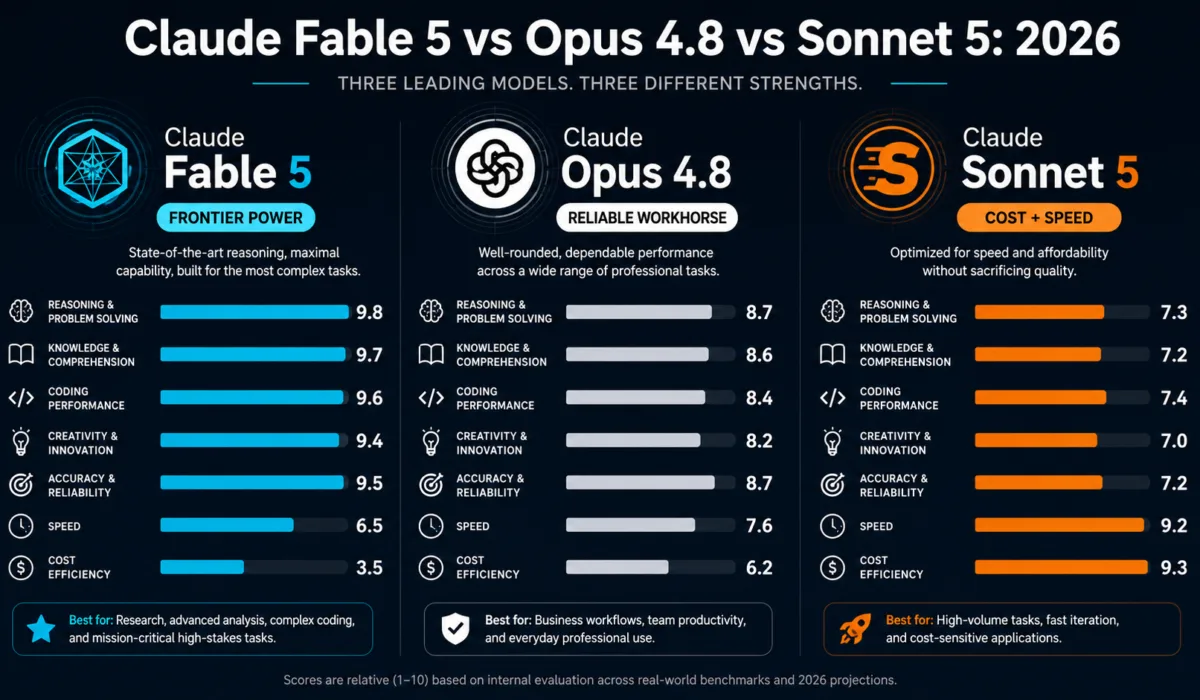
Claude Opus 4.8 arrived on May 28, 2026 as the new flagship for daily agentic work. Claude Fable 5 launched on June 9 as the first Mythos-class model open to the public, was suspended three days later, and came back on July 1. Claude Sonnet 5 followed on June 30 as the affordable option that narrows the gap between Sonnet and Opus.
Three models, three price points, three different jobs. Pick the wrong one and you either pay up to five times more per token than you need to, or you leave capability on the table when your work really needs it.
This Claude Fable 5 vs Opus 4.8 vs Sonnet 5 guide covers what separates the three, when each is worth the money, and what has changed since summer. Every figure links to its source.
October 2026 Update: All Three Models Have Moved On
A lot has happened since this Claude Fable 5 vs Opus 4.8 vs Sonnet 5 comparison first ran. Here’s what’s different now.
Fable 5.1 replaced Fable 5 on September 1. It keeps the same $10/$50 per million token price, and Anthropic’s Fable page says cache reads now cost $0.25 per million tokens, 75% less than on Fable 5. Anthropic also reports better benchmark results for 5.1 on coding and knowledge work.
Opus 4.8 is now a legacy model. Anthropic released Claude Opus 5 over the summer and moved Opus 4.8 to its legacy list, according to Morph’s Opus 4.8 guide. Then on September 22 it released Claude Opus 5.5 at $4/$20 per million tokens, cheaper than Opus 4.8’s $5/$25. Anthropic positions Opus 5.5 at Fable 5.1’s level on most work, as covered in eesel’s Opus 5.5 pricing breakdown.
Sonnet 5’s $2/$10 price is permanent. It launched as an introductory rate due to rise to $3/$15 after August 31. Anthropic’s Sonnet 5 announcement now confirms $2/$10 became permanent on August 10.
Fable now offers zero data retention to some customers. Fable keeps prompts and outputs for 30 days by default for safety monitoring, but Anthropic’s Fable page now says eligible enterprise customers can use Fable 5.1 with zero data retention.
So if you’re choosing today, the live version of this decision is Fable 5.1 vs Opus 5.5 vs Sonnet 5. The logic below still applies. Read “Fable” as Fable 5.1, and treat Opus 5.5 as the Opus to pick for any new project.
The 30-Second Verdict on Claude Fable 5 vs Opus 4.8 vs Sonnet 5
Choose Fable (now 5.1) if you run long autonomous coding sessions or multi-day agents and need the frontier of what Anthropic offers. You pay $10/$50 per million tokens for it.
Choose Opus if you do serious knowledge work, complex coding or accuracy-critical analysis. Opus 4.8 filled this role at launch. For new work, Opus 5.5 does it for less.
Choose Sonnet 5 if you want most of Opus’s capability at a fraction of the price. It suits high-volume workflows, standard agentic tasks and teams watching their token budget.
Most workflows should default to Sonnet 5 and escalate only when a task needs more.
What Changed in Anthropic’s Model Lineup
Before June 2026, Anthropic’s lineup was simple: Opus for maximum capability, Sonnet for balance, Haiku for speed and cost.
June added a fourth tier above Opus, the Mythos class. Claude Fable 5 is the publicly available Mythos-class model. Claude Mythos 5 shares the same underlying model with the safeguards lifted, and is limited to Project Glasswing partners and vetted researchers, according to DataCamp’s Fable 5 guide.
That’s why the Claude Fable 5 vs Opus 4.8 vs Sonnet 5 comparison isn’t like-for-like. Fable isn’t a bigger Opus. It sits in a different tier with different rules.
Then came the suspension. On June 12, Anthropic suspended access to both Fable 5 and Mythos 5 to comply with US Department of Commerce export controls. Commerce lifted the controls on June 30, and Anthropic’s statement confirms access was restored on July 1.
Claude Fable: The Frontier Option
Anthropic built Fable for long, complex tasks that run with little supervision. Inside agent harnesses like Claude Code, it plans across stages, writes and runs its own tests, and checks its work before calling a task done. DataCamp reports it can pull exact numbers from scientific figures and rebuild web applications from screenshots.
The key facts:
- $10 per million input tokens, $50 per million output tokens
- Cache reads at $0.25 per million tokens on Fable 5.1
- US-only inference available at 1.1 times standard pricing
- 30-day data retention by default, with zero data retention for eligible enterprise customers
- Available on the Claude Platform, Amazon Web Services, Google Cloud and Microsoft Foundry, and on Pro, Max, Team and Enterprise plans
Sources: Anthropic’s Fable page and DataCamp.
Where Fable shines:
- Hard software engineering. On SWE-Bench Pro, DataCamp reports Fable 5 at 80.3% against 69.2% for Opus 4.8. Note that 80.3% is Anthropic’s own result, and some independent reviewers have questioned it.
- Long agent workflows. Planning a multi-stage project, carrying it out and checking the result is the job Fable was designed for.
- Document-heavy specialist work. Finance, legal and research tasks with charts, tables and figures inside long files play to its vision strengths.
The trade-offs:
- Price. Fable costs twice Opus 4.8, two and a half times Opus 5.5, and five times Sonnet 5. Long autonomous sessions burn through tokens quickly.
- Safety rerouting. Classifiers send some requests in sensitive areas to a less capable model. DataCamp reports this affected fewer than 5% of all queries on Fable 5. Anthropic’s Fable page now says cybersecurity queries go to Opus 4.8 and biology queries go to Opus 5. Rerouted requests are billed at the cheaper model’s rate.
- Data retention by default. Unless you qualify for zero data retention, prompts and outputs are kept for 30 days. That alone can rule Fable out for regulated work.
Who should use Fable in the Claude Fable 5 vs Opus 4.8 vs Sonnet 5 decision: engineering teams running long autonomous coding sessions, researchers on multi-day deliverables, and anyone building agent harnesses that need frontier capability. If your work doesn’t involve autonomous agents or multi-hour tasks, Fable is overkill.
Claude Opus 4.8: The Former Workhorse
Opus 4.8 launched on May 28, 2026 as Anthropic’s recommended model for complex agentic coding and enterprise work. It costs $5/$25 per million tokens, supports a 1 million token context window and produces up to 128,000 output tokens per request, according to Morph.
Fable overshadowed it two weeks later, but for most of the summer Opus 4.8 was the sensible middle option in the Claude Fable 5 vs Opus 4.8 vs Sonnet 5 lineup: real capability without Fable’s price or rerouting.
Where Opus 4.8 shines:
- Complex knowledge work that doesn’t need multi-day autonomy: financial modeling, legal review, strategic analysis
- Serious coding in interactive sessions, at half Fable’s price
- Cybersecurity work. Anthropic recommends Opus 4.8 for legitimate security work, and Fable itself reroutes cyber requests to it
- Long outputs, with up to 128,000 tokens per request
The trade-offs:
- Legacy status. Anthropic now steers new work toward its newer Opus models.
- More expensive than Opus 5.5. At $5/$25, it costs 25% more than Opus 5.5’s $4/$20.
- Two and a half times Sonnet 5’s price, which adds up fast on high-volume work.
If you already run Opus 4.8 in production, it still works. The question is whether Opus 5.5 does the same work for less. One warning before switching: Opus 5.5 introduced breaking API changes, which our Claude Opus 5.5 pricing guide lists with a migration checklist.
Claude Sonnet 5: The Value Option
Sonnet 5 launched on June 30, 2026, one day before Fable’s return, so it flew under most people’s radar. For everyday budgets, it may be the most important model in the Claude Fable 5 vs Opus 4.8 vs Sonnet 5 lineup.
Anthropic’s announcement calls it the most agentic Sonnet model yet, able to plan, use tools like browsers and terminals, and run autonomously.
The key facts:
- $2 per million input tokens, $10 per million output tokens, now permanent
- 1 million token context window
- Adjustable effort setting to trade speed and cost against depth
- Updated tokenizer that can turn the same text into roughly 1.0 to 1.35 times as many tokens
Where Sonnet 5 shines:
- High-volume production, at 40% of Opus 4.8’s price and 20% of Fable’s
- Agentic tasks below the frontier: browser automation, terminal work and multi-step tool use
- Knowledge work, where it scores level with Opus 4.8 on GDPval-AA v2 (1,618 vs 1,615), per Eden AI
- Prototyping before you commit to Opus or Fable pricing
The trade-offs:
- Not frontier capability. On the hardest coding benchmarks, Opus and Fable still lead.
- Limited cybersecurity ability. Anthropic says it didn’t train Sonnet 5 on cyber tasks and recommends Opus for that work.
- High effort eats the savings. Running Sonnet 5 at its highest effort uses many more tokens.
For a deeper two-way breakdown, see our Claude Sonnet 5 vs Opus 4.8 guide.
Claude Fable 5 vs Opus 4.8 vs Sonnet 5: The Benchmark Numbers
Here’s how the three models compare on published benchmarks. Fable 5 and Opus 4.8 figures come from DataCamp. Sonnet 5 figures come from Eden AI and Emergent.
| Benchmark | Claude Fable 5 | Claude Opus 4.8 | Claude Sonnet 5 |
|---|---|---|---|
| SWE-Bench Pro (agentic coding) | 80.3% | 69.2% | 63.2% |
| Terminal-Bench 2.1 | 88.0% | 82.7% | 80.4% |
| OSWorld-Verified (computer use) | 85.0% | 83.4% | 81.2% |
| Humanity’s Last Exam (with tools) | 64.5% | 57.9% | 57.4% |
Treat this table as a rough guide. These are mostly vendor-reported results, the Sonnet 5 column comes from different sources than the other two, and published Opus 4.8 figures for Terminal-Bench and OSWorld vary between sources. Our guide on how to read AI benchmarks explains why you should test on your own tasks before trusting any single score.
The pattern is still clear. Fable leads everywhere, with its biggest margin on SWE-Bench Pro. Opus 4.8 and Sonnet 5 sit close together, and the gap between them is smallest on reasoning and computer use.
The Claude Fable 5 vs Opus 4.8 vs Sonnet 5 Comparison Table
| Feature | Claude Fable 5 / 5.1 | Claude Opus 4.8 | Claude Sonnet 5 |
|---|---|---|---|
| Tier | Mythos class | Opus | Sonnet |
| Status (October 2026) | Replaced by Fable 5.1 | Legacy, Opus 5.5 is current | Current |
| Input (per 1M tokens) | $10 | $5 | $2 |
| Output (per 1M tokens) | $50 | $25 | $10 |
| Cost vs Sonnet 5 | 5x | 2.5x | Baseline |
| Context window | 1M tokens | 1M tokens | 1M tokens |
| Safety rerouting | Yes, in cyber and biology | No | No |
| Data retention | 30 days by default, zero retention for eligible enterprises | Standard | Standard |
| Best for | Long autonomous agents, hardest coding | Complex work, cybersecurity | High-volume production |
Prices are from Anthropic’s pricing page and Benchlm’s API pricing tracker.
Claude Fable 5 vs Opus 4.8 vs Sonnet 5: What Each Costs in Practice
Take a team that sends 10 million input tokens and 2 million output tokens a month, before caching or batch discounts:
| Model | Monthly cost |
|---|---|
| Claude Fable 5.1 | $200 |
| Claude Opus 4.8 | $100 |
| Claude Opus 5.5 | $80 |
| Claude Sonnet 5 | $40 |
The same work costs five times more on Fable than on Sonnet 5. That gap is why the routing decision matters more than the choice of any single model.
Batch processing cuts every rate in half for jobs that can wait, and cached input costs a small fraction of the normal price. Both apply to all four models, so they shrink the bill without changing the ratios. Our Claude pricing guide covers every discount in detail.
When to Use Each Model
The price gaps in the Claude Fable 5 vs Opus 4.8 vs Sonnet 5 lineup are wide, so getting the choice right matters.
Choose Fable 5.1 when:
- Your task needs multi-hour or multi-day autonomous execution
- You’re building agent harnesses that plan, test and check their own work
- You need the strongest coding results Anthropic offers and the price is justified by the work
- You can accept 30-day data retention, or you qualify for zero retention
Choose Opus when:
- You need Opus-tier capability without Fable’s price
- Your work happens in interactive sessions with human review
- The task is legitimate cybersecurity work
- You need very long outputs in one request
- You’re starting fresh, in which case pick Opus 5.5 over Opus 4.8
Choose Sonnet 5 when:
- Per-token cost affects your margins
- The work is high-volume and standard difficulty
- You’re running agentic tasks that don’t need frontier capability
- You want to prototype before committing to Opus or Fable pricing
Start with Sonnet 5. Move to Opus when you hit real capability limits, and to Fable only when you specifically need Mythos-class power.
What About Claude Code?
If you work in Claude Code, the Claude Fable 5 vs Opus 4.8 vs Sonnet 5 choice ties into how you run sessions.
Fable’s strengths show up most inside an agent harness, where it can plan across stages, delegate and verify its own work over long sessions. Opus and Sonnet work well in Claude Code too, but tend to do best in shorter sessions with human checkpoints.
A practical pattern for most Claude Code users:
- Build and iterate on Sonnet 5
- Switch to Opus 5.5 when Sonnet stalls on a hard problem
- Save Fable 5.1 for long autonomous sessions that really need it
Don’t burn Fable tokens on work Sonnet 5 handles well.
Claude Plans and Subscription Access
Fable, Opus and Sonnet are all available on paid Claude plans, but Fable usage works differently from the other two models in the Claude Fable 5 vs Opus 4.8 vs Sonnet 5 lineup. When Fable 5 launched, subscribers got a short window of access within their normal limits, after which further Fable use required usage credits on top of the subscription, according to DataCamp. Check your plan’s current terms before relying on Fable for heavy daily work.
Current plan prices, per Benchlm’s plan breakdown:
- Pro: $20/month, or $17 billed annually, including Claude Code
- Max: $100 or $200/month for much higher limits
- Team: $25 per seat per month, or $20 billed annually, with Premium seats at $125 or $100, for 2 to 150 people
- Enterprise: custom pricing on an annual contract, with usage billed at API rates
If you’re deciding, start with Claude Pro and move up only when you consistently hit its limits. For production applications, the pay-as-you-go API usually fits better, since you pay only for the tokens you use.
The Alternatives Worth Considering
The Claude Fable 5 vs Opus 4.8 vs Sonnet 5 debate assumes you’re staying with Anthropic. Other options are worth testing:
- OpenAI’s GPT-6 Sol costs $2/$10 per million tokens, the same as Sonnet 5, and GPT-6 Astra matches Fable’s $10/$50. See our GPT-6 pricing guide and GPT-6 vs Claude Opus 5.5 comparison.
- Claude Haiku 4.5, at $1/$5, handles classification, extraction and short replies at half Sonnet’s price.
- MiniMax competes on price for speed-sensitive work. See our MiniMax vs Claude vs ChatGPT comparison.
- GLM is an option for Chinese-language and high-volume automation. See our GLM vs Claude vs ChatGPT comparison.
- Multi-model platforms like Aymo AI bundle many models for a flat monthly fee. See our Aymo AI pricing guide.
The right choice depends on your workflow, not on loyalty to one vendor.
FAQs
1. Is Claude Fable worth twice the price of Opus 4.8?
Only for specific workflows. Of all the Claude Fable 5 vs Opus 4.8 vs Sonnet 5 trade-offs, this is the one to get right. If you run long autonomous agent sessions or need the strongest coding results available, Fable can justify the premium. For standard professional work, Opus does the job for less, and Opus 5.5 costs 60% less than Fable per token.
2. What is the difference between Fable 5 and Fable 5.1?
Fable 5.1, released September 1, 2026, keeps the $10/$50 per million token price but cuts cache reads to $0.25 per million tokens, 75% less than Fable 5. Anthropic also reports better benchmark results for 5.1 on coding and knowledge work.
3. Why does Claude Fable sometimes reroute my request?
Fable uses safety classifiers that send some requests in sensitive areas to a less capable model. According to Anthropic’s Fable page, cybersecurity queries go to Opus 4.8 and biology queries go to Opus 5. You’re billed at the cheaper model’s rate for rerouted requests.
4. Is Claude Sonnet 5’s $2/$10 price permanent?
Yes. Sonnet 5 launched at an introductory $2/$10 that was due to rise to $3/$15 after August 31, 2026. Anthropic made $2/$10 permanent on August 10, 2026.
5. Can I use zero data retention with Claude Fable?
Fable keeps prompts and outputs for 30 days by default for safety monitoring. Anthropic now says eligible enterprise customers can use Fable 5.1 with zero data retention. For everyone else, the 30-day default applies.
6. Is Opus 4.8 still available?
Yes, but it’s on Anthropic’s legacy list. For new projects, Opus 5.5 is cheaper at $4/$20 per million tokens and is Anthropic’s current Opus model.
7. Which Claude model should I use for coding?
Default to Sonnet 5 for day-to-day coding, move to Opus 5.5 for hard debugging and complex refactors, and keep Fable 5.1 for long autonomous coding sessions where its lead on the hardest benchmarks matters.
8. What is the difference between Claude Fable 5 and Claude Mythos 5?
They share the same underlying model. Fable runs with safety classifiers and is publicly available. Mythos runs with the safeguards lifted and is limited to Project Glasswing partners and vetted researchers.
Final Verdict on Claude Fable 5 vs Opus 4.8 vs Sonnet 5
The Claude Fable 5 vs Opus 4.8 vs Sonnet 5 question has a plain answer: use the cheapest model that does the job well.
For most workflows, that’s Sonnet 5. It handles standard coding, writing, analysis and agentic tasks at a permanent $2/$10, and it matches Opus 4.8 on knowledge work.
When you keep hitting Sonnet’s limits on hard reasoning or difficult debugging, move to Opus. Opus 4.8 did that job well, but Opus 5.5 now does it for less.
Reach for Fable 5.1 only when you need Mythos-class capability: long autonomous agents, the hardest coding and frontier work in specialist fields. The premium is justified for those jobs and wasted on everything else.
The three tiers will keep shifting as Anthropic ships new versions. The decision won’t change: match the model to the task, and let your budget follow.

Mahdi Ayadi writes and edits AI Empire Media. He covers AI models, tools and pricing with one question in mind: is this actually worth paying for?
Before writing about software, Mahdi spent more than seven years selling it, in B2B SaaS sales and account management across cybersecurity, marketing technology and travel technology. That experience shapes how he reads vendor pricing pages, benchmark claims and feature lists, and it’s why his articles focus on real costs, trade-offs and sources readers can check for themselves.
He also builds AI-powered automation for sales and onboarding workflows, which informs his coverage of AI agents and automation tools. He works in English, French, Arabic and Russian.