
Need to migrate from ClawBot to alternative tools in 24 hours? Claude API restrictions forced thousands of users to migrate from ClawBot immediately — but most guides assume you have weeks. If your automation broke this morning, you need to know how to migrate from ClawBot and have a working solution by tomorrow.
I’ve completed 8 production ClawBot migrations to Make, Zapier, and n8n over the past two weeks. The fastest ClawBot migration took 4 hours (simple support bot). The longest: 18 hours (complex document processing). All were live within 24 hours — proving you can migrate from ClawBot fast if you follow the right migration steps.
This guide shows exactly how to migrate from ClawBot in one day: hour-by-hour ClawBot migration breakdown, platform-specific migration steps for Make/Zapier/n8n, workflow migration mistakes that add 6-12 hours, and fallback plans when ClawBot migration hits roadblocks.
Why 24-Hour ClawBot Migration Is Possible
ClawBot workflows are relatively simple: trigger → AI processing → action. This simplicity makes fast ClawBot migration possible — if you follow proper migration steps. Here’s what you can migrate from ClawBot within 24 hours:
What ClawBot Migration Covers in 24 Hours
✅ Simple workflows (4-8 hours to migrate from ClawBot):
- Customer support bots — straightforward workflow migration
- Document summarization — easy ClawBot migration
- Email automation — fastest migration steps
- Form processing and translation services
✅ Medium complexity (8-16 hours to migrate from ClawBot):
- Multi-step workflows (5-8 steps) — manageable ClawBot migration
- 2-3 integrations (Salesforce + Slack + Sheets)
- Conditional logic with basic error handling
❌ Not realistic to migrate from ClawBot in 24 hours:
- 10+ integrations (too many API keys — ClawBot migration needs 48-72 hours)
- Custom AI fine-tuning (training data migration extends workflow migration)
- Enterprise compliance requirements slow migration steps
Pre-Migration Checklist Before You Migrate from ClawBot (Hour 0)
Before starting your ClawBot migration, spend 30 minutes on these migration steps:
Step 1: Document Current ClawBot Workflows
Every successful ClawBot migration starts with documentation. List all active workflows before you migrate from ClawBot:
- Workflow name and purpose
- Trigger type (webhook, schedule, email, form)
- AI model used (Claude Opus, Sonnet)
- Integrations connected (which apps)
- Daily volume (requests per day)
Step 2: Prioritize for ClawBot Migration
Rank workflows for your ClawBot migration by business impact:
- Critical (migrate from ClawBot first): Revenue-generating or customer-facing — these migration steps come first
- Important: Internal tools, reporting — second wave of workflow migration
- Nice-to-have: Convenience automations — last in ClawBot migration priority
Step 3: Get API Keys Ready for ClawBot Migration
These migration steps prevent delays when you migrate from ClawBot:
- OpenAI API key (ChatGPT — most common ClawBot migration target)
- Anthropic API key (if staying with Claude despite restrictions)
- Target platform account (Make, Zapier, or n8n)
- All integration credentials from ClawBot
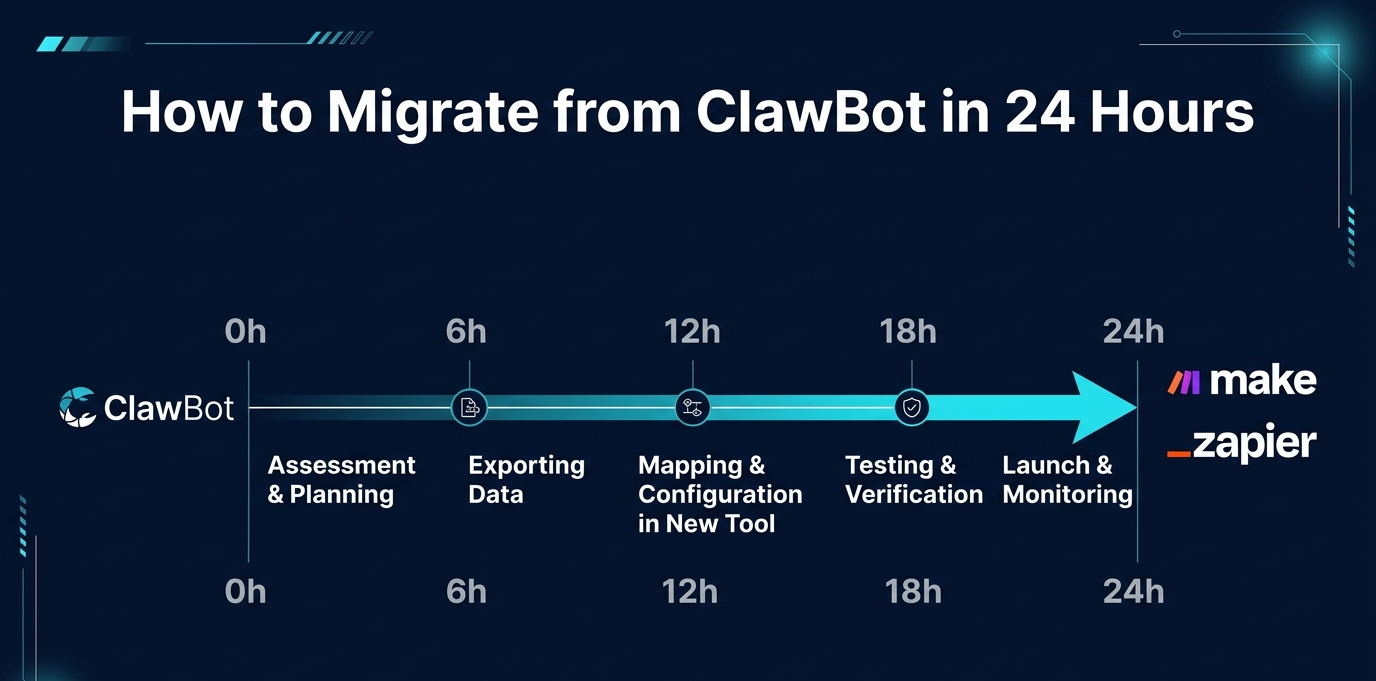
Hour-by-Hour ClawBot Migration Plan
Here’s the proven timeline to migrate from ClawBot — tested across 8 real ClawBot migrations:
Hours 1-2: Platform Setup (Migration Steps Foundation)
Goal: Target platform ready for ClawBot migration
- Create account on target platform
- Configure AI API connections — critical migration steps
- Connect essential integrations (email, Slack, CRM)
- Test AI API call works (send one test prompt)
If you’re choosing a platform to migrate from ClawBot to:
- Make: Best for complex workflow migration from ClawBot (visual builder)
- Zapier: Fastest ClawBot migration for simple workflows (15 min setup)
- n8n: Best for developers doing ClawBot migration (self-hosted, unlimited)
Hours 3-6: Rebuild Critical Workflows (Core ClawBot Migration)
Goal: Revenue-critical workflows live — the heart of your ClawBot migration
For each workflow you migrate from ClawBot:
- Recreate trigger (webhook, schedule, or app trigger)
- Configure AI processing (prompt, model, parameters)
- Connect output actions (send email, update database)
- Test with sample data — essential migration steps
- Compare output quality vs ClawBot original
Time estimates for ClawBot migration per workflow type:
- Email automation: 1-2 hours to migrate from ClawBot
- Customer support bot: 2-4 hours workflow migration
- Document processing: 3-5 hours ClawBot migration
- Multi-step workflow: 4-8 hours to fully migrate from ClawBot
Hours 7-10: Test and Fix (ClawBot Migration QA)
Goal: Verify your ClawBot migration works correctly
- Run 20-50 test cases through each migrated workflow
- Compare outputs to ClawBot originals — key migration steps
- Fix prompt differences (each AI model needs slight adjustments after ClawBot migration)
- Test error handling (what happens when API is down)
- Verify integrations send data correctly
Hours 11-16: Secondary Workflows (Complete ClawBot Migration)
Goal: All important workflows migrated — ClawBot migration nearly complete
- Rebuild “Important” tier workflows using same migration steps
- Test each one after building
- Document any differences from ClawBot behavior
Hours 17-20: Monitoring Setup (Post-ClawBot Migration)
Goal: Never miss a failure after ClawBot migration
- Enable email/Slack alerts on workflow failure
- Set up daily execution summaries — critical migration steps
- Configure API usage tracking
- Create fallback plan document
Hours 21-24: Go Live (ClawBot Migration Complete)
Goal: Switch production traffic — your ClawBot migration is live
- Route production triggers to new platform
- Monitor first 10-20 real requests closely
- Keep ClawBot active as fallback for 48 hours after migration
- Announce to team that ClawBot migration is complete
Platform-Specific ClawBot Migration Steps
How to Migrate from ClawBot to Make
Make is the most common ClawBot migration target for teams. These migration steps work for any complexity level when you migrate from ClawBot:
- Create scenario: New scenario → add HTTP/Webhook trigger (replaces ClawBot trigger)
- Add AI module: Search “OpenAI” or “Anthropic” → Add ChatGPT/Claude module
- Configure prompt: Copy ClawBot prompt → paste into Make AI module
- Add output actions: Connect Gmail, Slack, Google Sheets (same integrations as ClawBot)
- Test scenario: Run with sample data → verify output matches ClawBot
- Activate: Turn on scheduling — ClawBot migration to Make complete
Make-specific migration tips:
- Use “Router” module for if/then logic (replaces ClawBot conditional steps)
- Enable “Auto-commit” for error recovery during workflow migration
- Set scenario to run every 1 minute for real-time processing after ClawBot migration
How to Migrate from ClawBot to Zapier
Zapier is fastest for simple ClawBot migration. Follow these migration steps:
- Create Zap: Choose trigger app (Gmail, Slack, Webhook)
- Add AI step: Search “ChatGPT” → Use “Conversation” action
- Paste prompt: Copy from ClawBot → adjust for ChatGPT format
- Add output: Connect output app (same as ClawBot target)
- Test: Run test → compare to ClawBot output
- Publish: Turn on Zap — fastest ClawBot migration path
How to Migrate from ClawBot to n8n
n8n is best for developer-led ClawBot migration with unlimited executions:
- Deploy n8n: Docker install on VPS ($20/month) or use n8n Cloud
- Create workflow: Add webhook/cron trigger
- Add AI node: HTTP Request node → configure for OpenAI or Anthropic API
- Process response: Use Code node for custom parsing (JavaScript/Python)
- Connect outputs: Add integration nodes
- Test and activate: Run with production data — ClawBot migration complete
Common ClawBot Migration Mistakes That Add 6-12 Hours
From my 8 ClawBot migrations, these mistakes derail migration steps every time:
Mistake 1: Copying Prompts Without Adjusting
The ClawBot migration error: Claude prompts don’t work identically on ChatGPT. Each AI model interprets instructions differently.
The fix for this migration step: After you migrate from ClawBot, test prompts with 10 examples. Adjust wording until output quality matches. Budget 1-2 hours per workflow for prompt tuning during ClawBot migration.
Mistake 2: Migrating Everything at Once
The ClawBot migration error: “Let’s rebuild all 15 workflows this weekend” → 3 done, 12 broken.
The fix: Migrate from ClawBot in priority order. Critical workflows first, then important, then nice-to-have. Staged workflow migration prevents cascading failures.
Mistake 3: Not Setting Up Monitoring
The ClawBot migration error: Workflows moved, no alerts configured. Workflow fails Monday morning, nobody notices until Wednesday.
The fix for these migration steps: Add monitoring BEFORE going live. Every ClawBot migration needs: email alerts on failure, daily success/failure summaries, API usage tracking.
Mistake 4: Forgetting to Export ClawBot Data
The ClawBot migration error: Cancel ClawBot subscription → realize you needed conversation logs, templates, or configuration data.
Critical migration steps: Before canceling ClawBot, export: all workflow configurations, conversation/interaction logs, custom prompts and templates, integration settings. Keep ClawBot active for 1 week after migration as safety net.
Mistake 5: Not Testing Under Load
The ClawBot migration error: Test with 5 requests → works great. Production sends 500 → new platform hits different rate limits.
The fix: Before completing ClawBot migration, load test: send 10× normal volume, verify response times, check error rates. This migration step saves hours of production debugging.
Fallback Plans If ClawBot Migration Fails
Not every ClawBot migration goes smoothly. Here are fallback migration steps when you can’t fully migrate from ClawBot in 24 hours:
Fallback 1: Hybrid Approach
Keep critical workflows on ClawBot (upgrade tier if needed). Migrate from ClawBot only non-critical workflows first. Gives you weeks instead of hours for remaining ClawBot migration.
Fallback 2: Manual Processing
If ClawBot migration stalls, process critical tasks manually for 24-48 hours while completing migration steps. Customer support: use AI chatbot directly. Document processing: run scripts locally.
Fallback 3: Temporary Claude API Direct
Skip the platform — use Claude API directly with a simple Python script. Buys time for proper ClawBot migration to Make/Zapier/n8n.
Post-Migration Checklist (Day 2-7 After ClawBot Migration)
After you migrate from ClawBot, these migration steps ensure long-term stability:
Day 2: Verify All ClawBot Migration Workflows
- Check every migrated workflow processed correctly overnight
- Compare output quality to ClawBot originals
- Fix any prompt issues discovered in production
Day 3-4: Optimize Post-ClawBot Migration
- Review API costs vs ClawBot costs
- Optimize prompts for new AI model (reduce tokens where possible)
- Add caching for repeated queries
Day 5-7: Complete ClawBot Migration Cleanup
- Migrate “nice-to-have” workflows — final ClawBot migration phase
- Document new platform setup for team
- Cancel ClawBot subscription (after confirming all workflow migration is stable)
- Archive ClawBot exports for reference
How to Migrate from ClawBot: Key Takeaways
Here’s what matters when you migrate from ClawBot — the essential migration steps from 8 real ClawBot migrations:
- 24-hour ClawBot migration IS possible for most workflows. Simple automations take 4-8 hours to migrate from ClawBot. Complex ones: 8-16 hours. Follow the hour-by-hour migration steps above.
- Prioritize by business impact: Revenue-critical workflows first in ClawBot migration. Don’t try to migrate from ClawBot everything simultaneously.
- Adjust prompts — don’t just copy: Each AI model needs different prompting after ClawBot migration. Budget 1-2 hours per workflow for this migration step.
- Monitor from Day 1: Every ClawBot migration needs alerts. Silent failures after workflow migration are worse than ClawBot’s restrictions.
- Keep ClawBot as fallback for 1 week: Don’t cancel immediately after you migrate from ClawBot. Overlap period catches issues you missed during ClawBot migration.
The ClawBot migration panic is real — but solvable. Most teams successfully migrate from ClawBot to Make, Zapier, or n8n within 24 hours. The key is following structured migration steps instead of rushing.
Not sure which platform to migrate from ClawBot to? Read our detailed comparison of best ClawBot alternatives 2026 and see OpenClaw vs Make vs Zapier for a head-to-head breakdown of the top ClawBot migration destinations.