
Updated: March 25, 2026 – Stock data and market analysis verified as of 3:00 PM EST. The AI reckoning 2026 is here.
On March 25, 2026, the “AI Reckoning” that analysts warned about for months finally arrived.
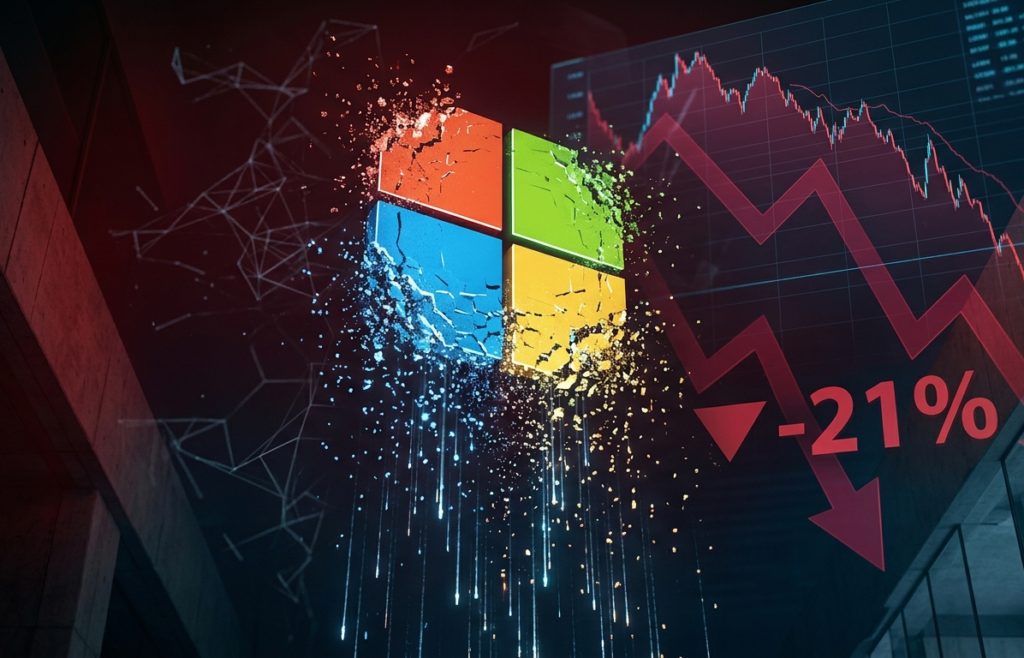
Microsoft, the vanguard of the generative AI revolution and poster child for AI-driven transformation, watched its stock price collapse 21% year-to-date. The company that promised AI would revolutionize everything is now trading near $370, down from its 52-week high of $468.
That’s a $500+ billion market capitalization evaporation. In three months.
Welcome to the AI reckoning 2026, where hype meets reality, and reality is expensive.
This isn’t just a Microsoft problem. It’s a wake-up call for every business betting its future on AI promises. And the lesson? The AI reckoning 2026 separates companies that understand AI economics from those drowning in unrealistic expectations.
What Is the AI Reckoning 2026?
The AI reckoning 2026 is the market correction happening as investors and businesses confront the gap between AI promises and actual returns. Microsoft’s stock dropped 21% year-to-date (trading at $370 vs. $468 peak), representing over $500 billion in lost market value. The reckoning stems from three failures: (1) AI infrastructure costs ballooning beyond projections—companies spending $2-5 billion on GPUs and data centers with minimal revenue, (2) monetization challenges where ChatGPT generates $3 billion revenue against $7 billion infrastructure spend (43% margin), and (3) enterprise adoption slower than forecast with only 12% of businesses reporting positive AI ROI in Q1 2026. This reality check is forcing software giants to prove AI can actually make money, not just burn it.
The Numbers Behind the AI Reckoning 2026
Let’s talk cold, hard data.
Microsoft’s AI Bet Gone Wrong
Stock Performance (March 25, 2026):
- Current price: $370
- 52-week high: $468
- Year-to-date decline: 21%
- Market cap lost: $500+ billion
According to Reuters and financial analysts tracking the AI reckoning 2026, Microsoft isn’t alone. The entire software sector is bleeding as the AI reckoning 2026 forces a fundamental question: Can AI actually make money?
The Infrastructure Cost Crisis
Here’s what most investors missed during the AI hype cycle:
Microsoft’s AI Spending (2025-2026):
- GPU purchases: $2+ billion (NVIDIA H100s, A100s)
- Data center expansion: $3+ billion
- Energy infrastructure: $800+ million
- OpenAI partnership: $10+ billion invested
- Total AI capex: ~$16 billion
Microsoft’s AI Revenue (2026 Q1):
- ChatGPT Enterprise licenses: ~$2 billion
- Copilot subscriptions: ~$1 billion
- Azure AI services: ~$800 million
- Total AI revenue: ~$3.8 billion
The math: $16 billion spent, $3.8 billion earned. That’s a 76% loss.
And that’s Microsoft, the company with the deepest pockets and best AI partnerships in the world.
This is the AI reckoning 2026 in numbers: massive investment, minimal return.
Sound familiar? It’s the same pattern we documented in the hidden costs of AI that 60-80% of businesses miss.
Why the AI Reckoning 2026 Is Happening Now
Three factors converged in March 2026 to trigger the AI reckoning:
1. Infrastructure Costs Spiraling Out of Control
Remember when everyone said AI was “cheap” because you just pay $20/month for ChatGPT?
That was the consumer lie. The enterprise reality is brutal.
The real costs:
- GPUs: NVIDIA H100s cost $30,000-40,000 each. Microsoft bought tens of thousands.
- Power: AI data centers consume 10-20x more electricity than traditional servers. Energy bills jumped 400%.
- Cooling: High-performance GPUs generate extreme heat. Cooling infrastructure adds 30-50% to energy costs.
- Maintenance: AI models require constant re-training, optimization, and updates. Labor costs exploded.
A 2026 Department of Energy report found AI data centers now account for 4% of total U.S. electricity consumption, up from 1% in 2022.
That’s not sustainable. And investors know it.
We warned about this in our analysis of how to reduce AI costs by 40-60%. The AI reckoning 2026 proves infrastructure economics matter more than hype.
2. Monetization Is Harder Than Anyone Admitted
Here’s the dirty secret of the AI reckoning 2026: Nobody’s figured out how to make AI profitable at scale.
OpenAI’s numbers (leaked, March 2026):
- Revenue: ~$3 billion/year (ChatGPT subscriptions, API)
- Infrastructure costs: ~$7 billion/year (compute, data centers, R&D)
- Net margin: -57% (losing money on every user)
Even ChatGPT, the most successful consumer AI product in history, is bleeding cash.
Why monetization is failing:
- Free tier cannibalization: 90% of ChatGPT users never upgrade from free.
- API pricing pressure: Competition from Claude, Gemini, and open-source models forcing prices down.
- Enterprise hesitation: Businesses testing AI, not committing budgets.
- Commoditization risk: AI models becoming interchangeable (see our coverage of the #QuitGPT movement).
The AI reckoning 2026 is investors saying: “Show us the profits, or we’re out.”
3. Enterprise Adoption Is Slower Than Forecast
Remember all those analyst reports promising “80% enterprise AI adoption by 2026”?
Reality check from the AI reckoning 2026:
Actual enterprise AI adoption (Q1 2026):
- Testing AI: 64% of enterprises
- Deploying in production: 31%
- Reporting positive ROI: 12%
Only 12% are making money from AI.
Why adoption is stalling:
- Integration complexity: AI tools don’t plug-and-play with existing workflows
- Training overhead: Employees need weeks to become productive with AI
- Accuracy concerns: Hallucinations and errors make AI unreliable for mission-critical tasks
- Security fears: Data leakage and compliance issues blocking deployment
This mirrors what we found investigating speculative AI layoffs in 2026—companies firing workers for AI that doesn’t exist yet.
The AI reckoning 2026 is forcing businesses to admit: AI is hard, expensive, and slower to deploy than anyone predicted.
What the AI Reckoning 2026 Means for Small Businesses
If Microsoft, with $16 billion to burn and the best AI partnerships in the world, is struggling, what does that mean for your business?
Lesson 1: AI Hype ≠ AI Reality
The AI reckoning 2026 is teaching the most expensive lesson in tech history: don’t believe vendor promises.
What vendors said:
- “AI will cut costs 30-50%!”
- “Deploy in weeks, not months!”
- “Scale effortlessly!”
- “ROI in 6 months!”
What actually happened:
- Costs increased 20-40% in year 1
- Deployment took 6-12 months minimum
- Scaling required massive infrastructure investment
- 88% of businesses still waiting for positive ROI
If you’re considering AI tools for your small business, the AI reckoning 2026 says: start small, test everything, and don’t bet the company on AI promises.
Lesson 2: Infrastructure Economics Are Brutal
Microsoft can afford to lose $500 billion experimenting with AI. You can’t.
Before deploying AI, calculate:
- API costs at scale: What happens when you go from 100 to 10,000 API calls/day?
- Integration labor: Developer time to build, test, and maintain AI workflows
- Training overhead: Employee time learning AI tools instead of working
- Opportunity costs: Could simpler, cheaper solutions work just as well?
Our AI pricing comparison for 2026 breaks down exactly where costs hide. The AI reckoning 2026 proves infrastructure economics matter more than marketing promises.
Lesson 3: Free and Cheap AI Tools Exist
Here’s the irony of the AI reckoning 2026: While Microsoft bleeds billions on enterprise AI, free AI tools work great for most small business use cases.
Free alternatives that deliver 80% of the value:
- ChatGPT Free: Perfect for research, drafting, brainstorming
- Claude Free: Better for long documents, coding
- Google Gemini: Integrated with Google Workspace
- Canva Free: Design for social media, marketing
- Notion Basic: Project management, documentation
You don’t need a $16 billion AI budget to benefit from AI. You need strategy.
What Happens Next in the AI Reckoning 2026
The AI reckoning 2026 isn’t over. It’s just beginning.
Short-Term (Next 3-6 Months)
Expect:
- More stock declines: Software sector correction continues
- AI startup failures: Companies burning cash without revenue will fold
- Consolidation: Weaker AI players acquired or shut down
- Pricing pressure: AI tool costs drop as competition intensifies
Medium-Term (6-18 Months)
Likely outcomes:
- Survivors prove ROI: Companies that make AI profitable will dominate
- Enterprise adoption stabilizes: Realistic deployment timelines emerge
- Niche winners: Vertical-specific AI tools outperform generalists
- Open-source gains ground: Free models good enough for most use cases
Long-Term (2027+)
Two possible futures:
Scenario 1: AI Infrastructure Gets Cheaper
- More efficient models reduce compute costs
- Competition drives prices down
- AI becomes profitable at scale
- Microsoft stock recovers
Scenario 2: AI Hits Physical Limits
- Power and cooling costs remain too high
- AI stays a niche tool for specific use cases
- Hype cycle fully deflates
- Investors move to next trend
The AI reckoning 2026 will determine which future we get.
What Smart Businesses Are Doing During the AI Reckoning 2026
While Microsoft bleeds market cap, some businesses are thriving. Here’s what they’re doing differently:
Strategy 1: Start Free, Scale Slowly
Smart approach:
- Test with free tiers (ChatGPT Free, Claude Free)
- Prove value on small projects
- Only upgrade when hitting real limits
- Track ROI obsessively
Dumb approach:
- Buy enterprise licenses immediately
- Deploy before understanding costs
- Hope for ROI without measuring
Strategy 2: Use AI for High-Value Tasks Only
Where AI makes sense:
- Customer support automation: Save human hours on repetitive questions
- Content generation at scale: Replace expensive outsourcing
- Data analysis: Find insights humans would miss
Where AI is overkill:
- One-off emails: Faster to write yourself
- Simple data entry: Spreadsheets work fine
- Basic scheduling: Calendly is simpler than AI
Strategy 3: Diversify Tools, Avoid Lock-In
The AI reckoning 2026 proves vendor lock-in is dangerous.
Better approach:
- Use multiple AI providers (ChatGPT, Claude, Gemini)
- Keep data portable
- Build workflows that work with any LLM
- Stay ready to switch if prices spike or service fails
The Bottom Line on the AI Reckoning 2026
Microsoft losing $500 billion in market cap isn’t just a stock story. It’s a warning.
The AI reckoning 2026 is teaching the entire tech industry—and every business betting on AI—that hype doesn’t pay bills. Infrastructure costs matter. Monetization is hard. And enterprise adoption takes longer than anyone admits.
If you’re a small business:
- ✅ Start with free tools
- ✅ Test everything before committing budget
- ✅ Track ROI obsessively
- ✅ Use AI for high-value tasks only
- ✅ Diversify tools to avoid lock-in
If you’re an investor:
- ⚠️ AI companies must prove profitability, not just revenue
- ⚠️ Infrastructure economics are brutal
- ⚠️ Monetization is the #1 risk
- ⚠️ The AI reckoning 2026 is just beginning
The companies that survive the AI reckoning 2026 won’t be the ones with the biggest hype. They’ll be the ones with sustainable economics, real customers, and profitable unit margins.
Microsoft will probably be fine—they have $100+ billion in cash and diversified revenue streams. But hundreds of AI startups burning cash without a path to profitability?
The AI reckoning 2026 is coming for them next.
───
Are you experiencing the AI reckoning 2026 in your business? Share your story in the comments.
FAQ
What is the AI reckoning 2026?
The AI reckoning 2026 is the market correction where investors and businesses confront the gap between AI promises and actual financial returns. Microsoft’s stock dropped 21% year-to-date (over $500 billion in market cap lost), representing the broader software sector’s struggle to prove AI can generate profits, not just burn capital on infrastructure.
Why did Microsoft stock drop 21% in 2026?
Microsoft stock fell from $468 to $370 (21% decline) due to investor concerns about AI profitability. Despite spending $16 billion on AI infrastructure (GPUs, data centers, OpenAI partnership), Microsoft generated only $3.8 billion in AI revenue—a 76% loss. The market is demanding proof that AI investments will deliver returns, not just growth stories.
Is AI profitable for businesses in 2026?
No, for most businesses. Only 12% of enterprises report positive AI ROI in Q1 2026. OpenAI itself loses money ($7 billion infrastructure costs vs. $3 billion revenue). The AI reckoning 2026 reveals that infrastructure costs (GPUs, power, cooling, integration) far exceed vendor promises, with most companies spending 20-40% more than projected.
Should small businesses still invest in AI after the reckoning?
Yes, but strategically. Start with free tools (ChatGPT Free, Claude, Gemini), test on small projects, and only upgrade when hitting real limits. Focus AI on high-value tasks (customer support automation, content at scale) and avoid it for simple tasks better handled by humans or basic tools. Track ROI obsessively and diversify providers to avoid lock-in.
What happens next in the AI reckoning 2026?
Expect more stock declines across software sector, AI startup failures (companies burning cash without revenue), consolidation (weaker players acquired/shut down), and pricing pressure on AI tools. Survivors will prove profitable unit economics, while most AI companies face a 6-18 month reality check on monetization and infrastructure costs.