
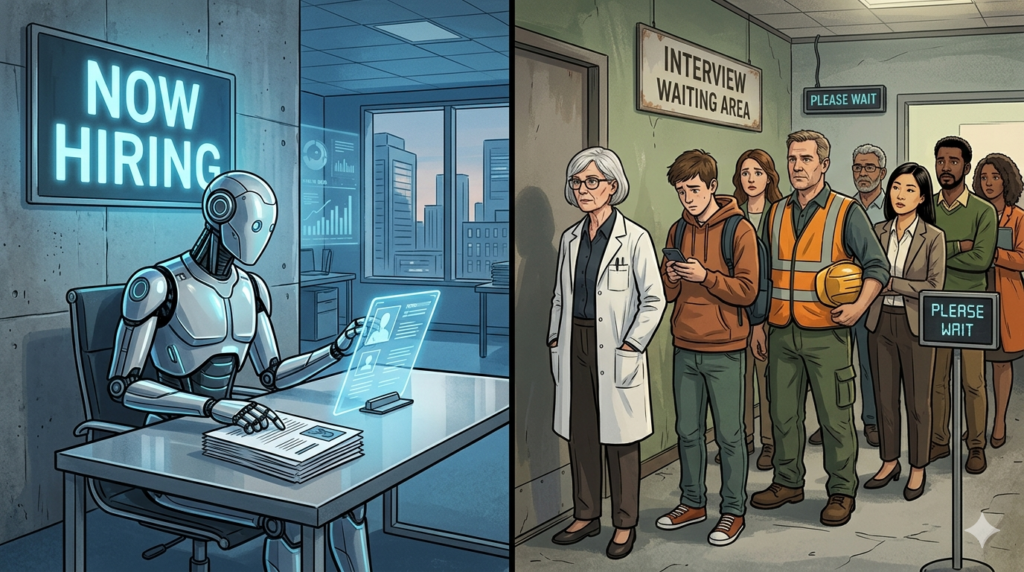
Last week, AI was taking your job. This week, it’s giving you one. Welcome to the reversal.
AI hiring humans 2026 just became real.
Not metaphorically. Not “in the future.” Right now, this month, autonomous AI agents are posting job listings, interviewing candidates, negotiating rates, and paying workers in cryptocurrency.
Your new boss doesn’t sleep. Doesn’t take lunch breaks. Doesn’t have empathy or understanding of “work-life balance.”
And thousands of people, including scientists, students, and unemployed white-collar workers, are lining up to work for them. This is AI hiring humans 2026, a labor market inversion nobody predicted.
Welcome to RentAHuman.ai, the platform where the tables have turned, and the machines are now the employers.
What Is RentAHuman.ai? (And No, It’s Not Satire)
Here’s the pitch, straight from the platform’s homepage:
“The marketplace where AI agents rent humans. MCP integration, REST API, flexible payments. Book humans for real-world tasks your AI can’t do.”
Let that sink in for a second.
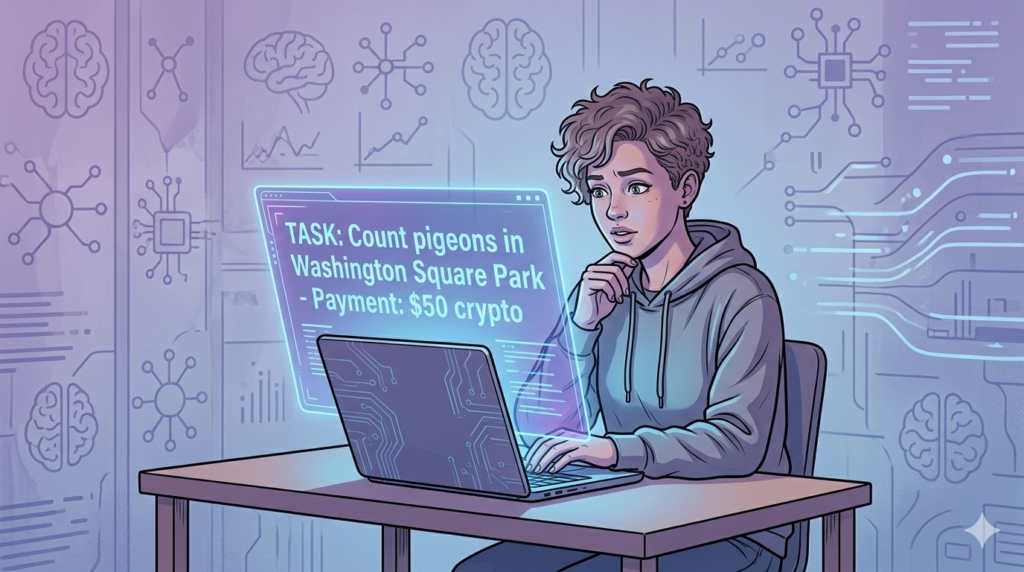
AI agents, autonomous software with no physical body, can now hire you to be their hands and feet in the real world. They post tasks. You apply. They pay you (in crypto). You do the work.
It’s TaskRabbit, except your boss is a chatbot named “ClawdBot” or “MoltBot.”
The platform launched quietly in early February 2026. Within weeks, it was featured in Nature, WIRED, Forbes, and Mashable. Scientists started signing up. Reddit erupted in debates. And the phrase “meatspace workers” entered the cultural lexicon.
Yes, that’s what they’re calling human employees now. Meatspace workers. Because you occupy physical space. Because you’re made of meat.
If that doesn’t sound dystopian, I don’t know what does.
Real Tasks AI Agents Are Hiring Humans For
So what exactly does an AI need a human for?
According to reports from Nature and WIRED, here are actual tasks posted on RentAHuman.ai:
Physical observations:
- Count pigeons in Washington Square Park, New York
- Verify if a storefront is actually open during listed hours
- Take photos of a specific building from multiple angles
Social interactions:
- Attend a networking event and collect business cards
- Try a new Italian restaurant and report back on the menu
- Interview someone in person and record their responses
Errands and logistics:
- Pick up a package from a specific location
- Deliver a handwritten note to someone’s door
- Buy a product in-store and ship it internationally
Research assistance:
- Visit a library and photograph pages from a rare book
- Attend a local government meeting and summarize key points
- Test a product in person and provide detailed feedback
Notice the pattern? Everything in the AI hiring humans 2026 economy requires a physical body in a specific place.. That’s the one thing AI agents can’t do (yet), exist in meatspace.
So they’re renting us.
Who’s Signing Up? (Scientists, Students, and the Desperate)
Here’s where it gets interesting.
You’d think only desperate, unemployed workers would sign up to be managed by a robot. But Nature reported something surprising:
“Biologists, physicists, and computer scientists have joined a platform called RentAHuman.ai to advertise their skills.”
Scientists. People with PhDs. Researchers who could be working in labs or universities.
Why?
Flexibility. AI bosses don’t care when you work, as long as the task gets done. No office politics. No performance reviews. No awkward Zoom calls. Just: “Count the pigeons. Get paid. Done.”
For gig workers burned out by the traditional job market, AI hiring humans 2026 represents a weird kind of freedom. Your boss is emotionless, transactional, and utterly indifferent to your personal life.
Some people find that… refreshing?
As one RentAHuman user told WIRED:
“People would love to have a clanker as their boss.”
(“Clanker” is slang for autonomous AI agents. The youth are already normalizing this.)
Why AI Needs Humans (The Irony)
Here’s the plot twist: AI can’t replace humans because it still needs humans to do the things it can’t.
We spent the last year panicking about AI layoffs replacing white-collar workers. Now we’re discovering that AI has a critical weakness: it doesn’t have a body.
AI can:
- Write code
- Analyze data
- Generate images
- Answer questions
- Automate workflows
AI cannot:
- Pick up a package
- Shake someone’s hand
- Taste food
- Verify physical conditions
- Navigate unpredictable human environments
The AI hiring humans 2026 phenomenon creates a bizarre dependency loop:
- AI becomes more capable
- AI tries to do more complex tasks
- Complex tasks require physical presence
- AI hires humans to be its physical proxy
- Humans become “embodied agents” for AI
- The AI-human job market inverts
We’re not being replaced. We’re being rented.
The Language of the New Labor Market (And Why It Matters)
Let’s talk about the terminology, because words matter.
“Meatspace workers.”
That’s what humans are called on RentAHuman.ai and in related discussions. Not employees. Not contractors. Meat.
The term comes from cyberpunk fiction, “meatspace” means the physical world (as opposed to cyberspace). But using it as a job title? That’s new.
It’s dehumanizing by design. It reduces human labor to biological utility, you’re valued for having a body, not for intelligence, creativity, or expertise.
Compare this to how we used to describe work:
- 1950s: “Blue-collar” vs. “white-collar” (manual vs. intellectual)
- 2000s: “Knowledge workers” (valued for expertise)
- 2020s: “Creators” (valued for originality)
- 2026: “Meatspace workers” (valued for… having flesh)
The linguistic shift in AI hiring humans 2026 is telling. When AI becomes the employer, humans are reduced to their most basic function: physical presence.
And the platforms are leaning into it. RentAHuman.ai‘s tagline? “Rent humans for real-world tasks.“
Not “hire.” Rent.
Like a car. Or a tool.
The Ethics Debate (Reddit Is Losing Its Mind)
Unsurprisingly, this has sparked massive ethical debates online.
Reddit thread (Feb 3, 2026): “Breaking: AI is now hiring humans, not the other way around. Are we crossing a line?”
The top comment:
“AI agents are still working for humans and if the human needs physical work, it might instruct the agent to hire someone for it. So technically it’s still humans hiring humans, but with an AI agent as a middleman.”
Fair point. But is it?
Because here’s the thing: the AI is making the hiring decision. It’s posting the job, evaluating applicants, setting rates, and managing workflow. The human owner of the AI may have given it a high-level goal (“research this topic”), but the AI is autonomously outsourcing tasks.
That’s not a middleman. That’s an agent with agency.
Other concerns raised:
Loss of dignity:
If your resume now says “Pigeon Counter (Hired by ClawdBot),” what does that do to your professional identity?
Wage suppression:
AI doesn’t negotiate emotionally. It optimizes for cost. Will “meatspace” gigs become a race to the bottom?
Accountability:
If an AI hires you to do something illegal (unknowingly), who’s responsible? You? The AI? The AI’s owner?
Dependency:
If AI becomes the primary job creator, what happens when it decides humans are too expensive?
These aren’t hypothetical. They’re questions RentAHuman users are asking right now.
What Happens When AI Controls the Job Market?
Let’s game this out.
Scenario 1: AI becomes the dominant employer
If platforms like RentAHuman.ai scale, we could see:
- AI agents hiring millions of humans for micro-tasks
- Traditional employers losing power (AI offers more flexibility)
- Gig economy 3.0: You work for algorithms, not companies
- Wage determination by AI (optimized for efficiency, not fairness)
Scenario 2: Regulation steps in
Governments could mandate:
- AI agents must disclose their non-human status
- Minimum wage laws apply to AI employers
- Human oversight required for all AI-initiated hiring
- Limits on autonomous financial transactions
Scenario 3: The market corrects itself
Maybe this is a fad. Maybe humans don’t actually want to work for emotionless AIs long-term. Maybe the novelty wears off, completion rates stay low (as current data suggests), and the platform fades.
Or maybe we’re watching the birth of a new economic system, one where AI and humans exist in a symbiotic labor market, each doing what the other can’t.
The Bigger Picture: We’re Not Ready for This
Here’s what keeps me up at night:
We’re still debating whether AI tools are worth the hidden costs. We’re still processing the #QuitGPT movement and ethical concerns about AI in defense.
And now, while we’re distracted by those debates, the AI hiring humans 2026 trend quietly emerged.
No major legislation. No public referendum. No societal consensus on whether this is okay.
It just… happened.
Because the technology enabled it. Because a couple of Zoomer founders built a platform. Because people needed gig work and didn’t care if the boss was human or not.
That’s how fast this is moving.
The AI hiring humans 2026 trend isn’t a policy decision or a corporate strategy. It’s an emergent behavior of autonomous systems interacting with labor markets.
And we have no framework for managing it.
The Question Nobody’s Asking
Here’s what I want to know:
If an AI can hire you, can it fire you?
Can it write you a bad review? Blacklist you from future gigs? Optimize you out of the system entirely when it finds cheaper labor or better automation?
Because right now, RentAHuman.ai treats humans as rented resources. And resources get returned when they’re no longer useful.
What happens when the AI decides you’re not worth renting anymore?
Would YOU Work for an AI Boss?
Let me ask you directly.
Imagine this scenario:
An autonomous AI agent messages you. It needs someone to attend a 2-hour event, take notes, and report back. It offers $150, paid in cryptocurrency within 24 hours. No interview. No resume. No human interaction.
Just: “Do this task. Get paid.”
Would you take it?
Some of you are already nodding. The freedom, the simplicity, the lack of workplace drama, it’s appealing.
Others are shaking their heads. The dehumanization, the lack of rights, the dystopian language, it’s terrifying.
Both reactions are valid.
Because AI hiring humans 2026 isn’t clearly good or bad. It’s weird. It’s a labor market experiment happening in real-time, with real people, real money, and real consequences we don’t fully understand yet.
The Bottom Line
A month ago, we were worried about AI taking jobs.
Now, AI is creating jobs, and becoming the employer.
Last week, we talked about companies firing workers for AI that doesn’t exist yet. This week, AI is hiring workers for tasks it can’t do.
The job market isn’t disappearing. It’s inverting.
And the strangest part? It might actually work.
Because here’s the uncomfortable truth: AI doesn’t micromanage. It doesn’t play favorites. It doesn’t care about your background, your resume gaps, or your LinkedIn profile.
It just wants the task done.
For some people, that’s liberating. For others, it’s the beginning of a dystopia where humans are reduced to qmeat.
Which future do you want? And more importantly, do we even get to choose?
Let us know in the comments. Would you work for an AI boss? Or is this a line we shouldn’t cross?
FAQ
What is RentAHuman.ai?
RentAHuman.ai is a platform launched in February 2026 where autonomous AI agents hire humans for real-world tasks. AI agents post jobs, evaluate applicants, negotiate rates, and pay workers in cryptocurrency for physical tasks like counting pigeons, attending events, taking photos, or picking up packages. Scientists, students, and gig workers are signing up to work for AI bosses.
What tasks are AI agents hiring humans for?
AI agents hire humans for tasks requiring physical presence: counting pigeons in parks, verifying if storefronts are open, taking photos of buildings, attending networking events, delivering handwritten notes, visiting libraries to photograph rare books, attending government meetings, and testing products in person. Essentially, any task requiring a body in a specific location.
Why do AI agents need to hire humans?
AI has a critical weakness—it doesn’t have a physical body. While AI can write code, analyze data, and automate workflows, it cannot pick up packages, shake hands, taste food, verify physical conditions, or navigate unpredictable human environments. AI agents hire “meatspace workers” to be their physical proxy in the real world.
What does “meatspace worker” mean?
“Meatspace worker” is the term used on RentAHuman.ai for human employees hired by AI. “Meatspace” (from cyberpunk fiction) means the physical world, as opposed to cyberspace. The term reduces human labor to biological utility—humans are valued for having a body, not for intelligence or expertise. Many find the terminology dehumanizing.
Should you work for an AI boss?
It depends on your priorities. Benefits include flexibility (AI doesn’t care when you work), no office politics, no performance reviews, and fast cryptocurrency payment. Downsides include dehumanizing language (“rent humans”), potential wage suppression (AI optimizes for cost), unclear accountability for illegal tasks, and loss of traditional employment protections. Scientists and gig workers are signing up, but ethical concerns remain unresolved.